第 18 章 Tools Agent:函数调用循环 ★★
本章目标:读完你能写出一个工具调用型 Agent 的完整循环,说清它的“短期记忆”(scratchpad)、“长期记忆”(memory)和迭代上限分别在哪里,并读懂 n8n Agent V3 的执行代码。前置:第 16、17 章。对应代码:mini-n8n v0.4 的
packages/nodes-ai/src/agent/execute.ts、nodes/agent.ts
1. 问题与概念
“Agent” 的核心就是一个循环:
messages = [system, ...历史, user]
loop:
    answer = model(messages, tools)
    if answer 没有工具调用:  return answer.content
    for call in answer.toolCalls:
        result = 执行工具(call)
        messages += [assistant(call), tool(result)]
早期的 ReAct 让模型在文本里写 “Thought: … Action: … Action Input: …”,再由程序用正则解析;现在主流模型都支持 原生函数调用,工具调用作为结构化字段返回,不再需要解析文本。n8n 的 Agent 节点经历了这个演进:老版本有 ReAct Agent、Conversational Agent、OpenAI Functions Agent 等多种(packages/@n8n/nodes-langchain/nodes/agents/Agent/agents/ 下还能看到),新版本统一为 Tools Agent。
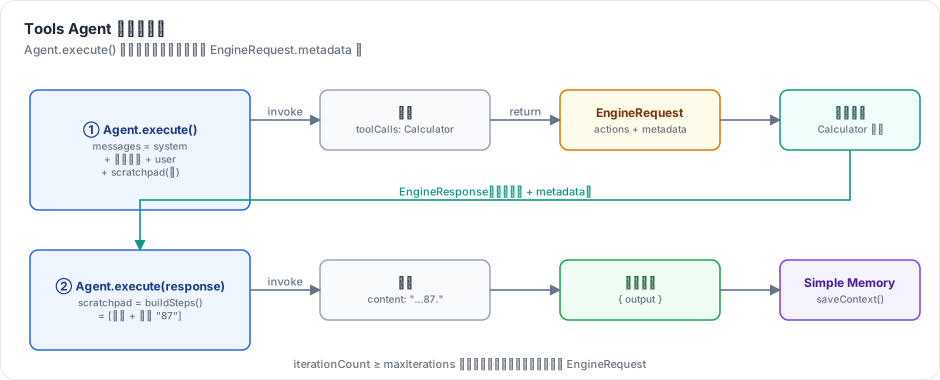
图 18-1:一次两轮的 Agent 执行。第一轮模型决定调用工具,Agent 不自己执行,而是返回一个 EngineRequest 交给引擎;引擎执行工具节点后把结果作为 EngineResponse 交还给 Agent;Agent 把“调用 + 结果”拼进 scratchpad,第二轮模型给出最终回答。
三种“记忆”要分清:
| 存在哪里 | 生命周期 | n8n 中的名字 | |
|---|---|---|---|
| scratchpad | 本次执行的 steps(工具调用及结果) | 一次 Agent 执行 | steps / intermediateSteps |
| 对话历史 | Memory 子节点 | 跨执行,按 sessionId | chat_history |
| 系统提示词 | Agent 参数 | 每次都发 | systemMessage |
2. n8n 是怎么做的
2.1 入口:toolsAgentExecute
// packages/@n8n/nodes-langchain/nodes/agents/Agent/agents/ToolsAgent/V3/execute.ts(节选)
export async function toolsAgentExecute(this: IExecuteFunctions | ISupplyDataFunctions, response?: EngineResponse<RequestResponseMetadata>) {
	let request: EngineRequest<RequestResponseMetadata> | undefined = undefined;
	const returnData: INodeExecutionData[] = [];
	...
	// Build execution context with shared configuration
	const executionContext = await buildExecutionContext(this);
	const { items, batchSize, delayBetweenBatches, model, fallbackModel, memory } = executionContext;
	...
	// Process items in batches
	for (let i = 0; i < items.length; i += batchSize) {
		const batch = items.slice(i, i + batchSize);
		const { returnData: batchReturnData, request: batchRequest, memoryHits } = await executeBatch(this, batch, i, model, fallbackModel, memory, response);
		...
		// Collect requests from batch
		if (batchRequest) {
			...
			if (!request) { request = batchRequest; } else { request.actions.push.apply(request.actions, batchRequest.actions); }
		}
	}

	// Return tool call request if any tools need to be executed
	if (request) {
		if (isExecuteFunctions(this)) {
			// Top-level execution — hand the request to the engine, which
			// schedules the requested tool nodes and resumes us with an
			// EngineResponse.
			return request;
		}
		// Sub-agent execution ...
		return await resolveSubAgentRequest(this, request, { runAgentBatch: async (engineResponse) => await toolsAgentExecute.call(this, engineResponse) });
	}
	...
	return [returnData];
注意 execute 的两个返回类型:要么是普通的 [returnData],要么是一个 EngineRequest。Agent 从不自己执行工具——它只把“我要调这些工具”交给引擎。这是 Agent V3 最重要的设计,第 19 章专门讲。唯一的例外是 Agent 自己作为另一个 Agent 的工具运行时(ISupplyDataFunctions),这时没有引擎可以调度,只能就地解决(resolveSubAgentRequest,第 23 章)。
2.2 每个 item:准备上下文
executeBatch 对批次里的每个 item 调用 prepareItemContext 和 runAgent:
// packages/@n8n/nodes-langchain/nodes/agents/Agent/agents/ToolsAgent/V3/helpers/prepareItemContext.ts:41-75(节选)
export async function prepareItemContext(ctx, itemIndex, response?, model?): Promise<ItemContext> {
	const steps = buildSteps(response, itemIndex);

	const input = getPromptInputByType({ ctx, i: itemIndex, inputKey: 'text', promptTypeKey: 'promptType' });
	if (input === undefined) {
		throw new NodeOperationError(ctx.getNode(), 'The "text" parameter is empty.');
	}

	const outputParser = await getOptionalOutputParser(ctx, itemIndex);
	const tools = await getTools(ctx, outputParser);
	const options = ctx.getNodeParameter('options', itemIndex) as AgentOptions;
	...
	// Prepare the prompt messages and prompt template.
	const messages = await prepareMessages(ctx, itemIndex, { systemMessage: options.systemMessage, ... });
	const prompt: ChatPromptTemplate = preparePrompt(messages);
buildSteps(response, itemIndex):从 EngineResponse 重建 scratchpad(2.4 节)。getPromptInputByType:提示词来自上游的chatInput字段(连着 Chat Trigger 时),或者参数里写死的文本。getTools:getInputConnectionData('ai_tool')拿到所有工具(第 16 章);如果接了输出解析器,还会加一个format_final_json_response工具(第 23 章)。prepareMessages:system 消息(默认'You are a helpful assistant',见ToolsAgent/prompt.ts:1)、chat_history占位、用户输入、agent_scratchpad占位。
2.3 调用模型:runAgent
createAgentSequence(V3/helpers/createAgentSequence.ts)用 LangChain 的 createToolCallingAgent 把模型、工具和提示词模板组装成一个 runnable,runAgent 调用它:
// packages/@n8n/nodes-langchain/nodes/agents/Agent/agents/ToolsAgent/V3/helpers/runAgent.ts(非流式分支,节选)
const chatHistory = await loadMemory(memory, model, options.maxTokensFromMemory);
...
const modelResponse = await executorWithTracing.invoke({ ...invokeParams, chat_history: chatHistory }, executeOptions);

if ('returnValues' in modelResponse) {
	...
	// Save conversation to memory including any tool call context
	if (memory && input && modelResponse.returnValues.output) {
		const previousCount = response?.metadata?.previousRequests?.length;
		await saveToMemory(input, modelResponse.returnValues.output, memory, steps, previousCount);
		...
	}
	...
	return result;
}

// If response contains tool calls, we need to return this in the right format
const actions = createEngineRequests(modelResponse, itemIndex, tools);

return {
	actions,
	metadata: buildResponseMetadata(response, itemIndex),
};
两条出路:
returnValues:模型给出最终回答。保存到记忆(只在最终回答时保存,中间的工具调用不会单独写入),返回{ output }。- 工具调用:
createEngineRequests把每个调用翻译成一个 action——关键是nodeName: foundTool.metadata?.sourceNodeName(utils/agent-execution/createEngineRequests.ts:232-236),也就是 哪个节点 要被执行。
2.4 跨“轮”的状态:metadata
Agent 每返回一次 EngineRequest,它的 execute() 就 结束 了;引擎执行完工具再 重新调用 它。两次调用之间不共享任何 JavaScript 变量,状态全在 request 的 metadata 里:
// packages/@n8n/nodes-langchain/utils/agent-execution/buildResponseMetadata.ts:17-28
export function buildResponseMetadata(response: EngineResponse<RequestResponseMetadata> | undefined, itemIndex: number): RequestResponseMetadata {
	const currentIterationCount = response?.metadata?.iterationCount ?? 0;

	return {
		previousRequests: buildSteps(response, itemIndex),
		itemIndex,
		iterationCount: currentIterationCount + 1,
	};
}previousRequests:截至目前的所有 steps。下一次被调用时,buildSteps用它加上新到达的工具结果,得到完整的 scratchpad:
// packages/@n8n/nodes-langchain/utils/agent-execution/buildSteps.ts:345-367(节选)
export function buildSteps(response, itemIndex): ToolCallData[] {
	const steps: ToolCallData[] = [];
	if (!response) return steps;
	const responses = response.actionResponses ?? [];
	if (response.metadata?.previousRequests) {
		steps.push(...response.metadata.previousRequests);
	}
	for (const tool of responses) {
		if (tool.action?.metadata?.itemIndex !== itemIndex) continue;
		...
		const existingStep = steps.find((s) => s.action.toolCallId === tool.action.id);
if (existingStep) continue;iterationCount:已经循环了几轮。每次进入时检查:
// packages/@n8n/nodes-langchain/nodes/agents/Agent/agents/ToolsAgent/V3/helpers/checkMaxIterations.ts(节选)
if (response.metadata.iterationCount >= maxIterations) {
	throw new NodeOperationError(node, `Max iterations (${maxIterations}) reached. The agent could not complete the task within the allowed number of iterations.`);
}
为什么状态不放在内存里?因为第 19 章会看到,工具节点是引擎调度的普通节点,执行过程可能被暂停、存进数据库、在另一个进程里恢复(人工审批工具就是这样,第 23 章)。只有放在可序列化的 metadata 里,Agent 才能在任何地方继续。
buildSteps.ts 的大部分代码在处理供应商差异:Anthropic 的 thinking 块、Gemini 的 thought signature、DeepSeek 的 reasoning content——它们要求下一轮请求原样带回上一轮的“思考”内容。这是生产级 Agent 实现里很容易被低估的部分。
3. 从零实现
mini-n8n 的 Agent 不依赖 LangChain,循环逻辑全在一个约 150 行的文件里。
3.1 状态
// code/mini-n8n/packages/nodes-ai/src/agent/execute.ts(节选)
/** One finished tool call: what the LLM asked for and what the tool returned */
export interface ToolCallStep {
	toolCallId: string;
	tool: string;
	toolInput: IDataObject;
	observation: string;
}

/** Kept in the EngineRequest so the Agent can continue where it stopped (n8n: RequestResponseMetadata) */
export interface AgentRequestMetadata extends IDataObject {
	/** item index -> steps of earlier iterations */
	previousRequests: Record<number, ToolCallStep[]>;
	iterationCount: number;
	/** item index -> final output, for items that are already done */
	finishedItems: Record<number, IDataObject>;
}
比 n8n 多一个 finishedItems:Agent 一次处理多个 item 时,有的 item 第一轮就答完了,有的还要调工具。已经完成的 item 记在 metadata 里,下一轮直接跳过,不重复调用模型。
3.2 scratchpad
// code/mini-n8n/packages/nodes-ai/src/agent/execute.ts(节选)
export function buildSteps(response: EngineResponse<AgentRequestMetadata> | undefined, itemIndex: number): ToolCallStep[] {
	if (!response) return [];
	const steps = [...(response.metadata.previousRequests?.[itemIndex] ?? [])];
	for (const { action, data } of response.actionResponses) {
		if (action.metadata.itemIndex !== itemIndex || steps.some((s) => s.toolCallId === action.id)) continue;
		steps.push({ toolCallId: action.id, tool: String(action.metadata.toolName ?? action.nodeName), toolInput: action.input, observation: observation(data) });
	}
	return steps;
}

/** The scratchpad: each step = an assistant message with the call + a tool message with the result */
function stepsToMessages(steps: ToolCallStep[]): ChatMessage[] {
	return steps.flatMap((s) => [
		{ role: 'assistant' as const, content: '', toolCalls: [{ id: s.toolCallId, name: s.tool, args: s.toolInput }] },
		{ role: 'tool' as const, content: s.observation, toolCallId: s.toolCallId },
	]);
}
observation() 把工具节点的运行记录(ITaskData)变成模型能读的字符串:取 data.ai_tool[0] 的 item;单个 { response } 字段就直接用它的值;出错时是 Error: <消息>。
3.3 主循环(一轮)
// code/mini-n8n/packages/nodes-ai/src/agent/execute.ts(节选)
const model = (await this.getInputConnectionData('ai_languageModel', 0)) as ChatModel;
// undefined when no memory sub-node is connected
const memory = (await this.getInputConnectionData('ai_memory', 0)) as ChatMemory | undefined;
const maxIterations = Number(this.getNodeParameter('options.maxIterations', 0, 10));
checkMaxIterations(response, maxIterations, this);
...
for (let i = 0; i < items.length; i++) {
	if (finishedItems[i]) continue;
	...
	const tools = flattenTools((await this.getInputConnectionData('ai_tool', i)) as unknown[]);
	const steps = buildSteps(response, i);
	const history = memory ? await memory.loadMessages() : [];
	const messages: ChatMessage[] = [{ role: 'system', content: systemMessage }, ...history, { role: 'user', content: prompt }, ...stepsToMessages(steps)];
	...
	const answer = await model.invoke(messages, { tools, signal: this.getExecutionCancelSignal(), onToken: ... });

	const calls = answer.toolCalls.filter((c) => tools.some((t) => t.name === c.name));
	if (calls.length) {
		previousRequests[i] = steps;
		for (const call of calls) {
			const tool = tools.find((t) => t.name === call.name)!;
			actions.push({
				actionType: 'ExecutionNodeAction',
				nodeName: tool.metadata.sourceNodeName,
				// a toolkit node (MCP) needs to know which of its tools was meant
				input: tool.metadata.isFromToolkit ? { ...call.args, tool: call.name } : call.args,
				type: 'ai_tool',
				id: call.id,
				metadata: { itemIndex: i, toolName: call.name },
			});
		}
		continue;
	}

	if (memory) await memory.saveContext(prompt, answer.content);
	finishedItems[i] = { output: answer.content, ... };
}

if (actions.length) {
	const metadata: AgentRequestMetadata = { previousRequests, iterationCount: (response?.metadata?.iterationCount ?? 0) + 1, finishedItems };
	return { actions, metadata };
}
一个模型回答里有多个工具调用时(并行调用),它们进入 同一个 EngineRequest,引擎会依次执行完所有工具再恢复 Agent。
模型可能“幻想”出一个不存在的工具名,calls 先过滤掉这些调用;如果全被过滤掉,就把模型的文本当作最终回答。
| 方面 | n8n Agent V3 | mini-n8n |
|---|---|---|
| 组装 | LangChain createToolCallingAgent + RunnableSequence | 手写消息列表 |
| 批处理 | batchSize + delayBetweenBatches | 逐 item,已完成的 item 记入 metadata |
| 记忆 | loadMemory 按 token 裁剪;保存时保留工具调用上下文 | 按轮数窗口;只存问答 |
| 备用模型 | fallbackModel(withFallbacks) | 无 |
| 供应商的思考内容 | thinking / thought signature / reasoning content 回传 | 无 |
| 输出解析器、HITL | 支持 | v0.5 |
4. 运行与验证
单元测试用 Mock 模型和计算器跑完整循环,并记录每个钩子事件(packages/nodes-ai/test/agent.test.ts):
expect(events).toEqual(['▶ Start', '✓ Start', '▶ Input', '✓ Input', '▶ AI Agent', '▶ Model', '✓ Model', '▶ Calculator', '✓ Calculator', '▶ Model', '✓ Model', '✓ AI Agent']);读这个序列:Agent 开始 → 第一次模型调用(决定调用工具)→ Calculator 作为一个节点执行 → 第二次模型调用(给出答案)→ Agent 结束。Agent 只有一个开始事件和一个结束事件,虽然它的 execute() 实际被调用了两次。其余断言(真实输出):
✓ AI Agent > lets the engine run the tool node and resumes with its result
✓ AI Agent > runs several tools requested in one step
✓ AI Agent > gives a tool error back to the model instead of failing
✓ AI Agent > stops after maxIterations用真实的本地小模型跑同样的结构(examples/ollama-agent.ts,Ollama + qwen2.5:0.5b),真实输出:
[    0 ms] Start      out={}
[    1 ms] Question   out={"chatInput":"A shirt costs 25 dollars. How much do 17 shirts cost?"}
[  129 ms] Ollama     out={"content":"","toolCalls":[{"id":"call_o7rr88cc","name":"Calculator","args":{"expression":"17 * 25"}}],"usage":{"promptTokens":188,"completionTokens":25}}
[  130 ms] Calculator in={"expression":"17 * 25"} out={"response":"425"}
[  225 ms] Ollama     out={"content":"The cost of 17 shirts is 425 dollars.","toolCalls":[],"usage":{"promptTokens":232,"completionTokens":15}}
[  225 ms] AI Agent   out={"output":"The cost of 17 shirts is 425 dollars."}

status: success
answer: The cost of 17 shirts is 425 dollars.
模型自己把应用题翻译成了算式 17 * 25。另一次问 “What is 1234 * 5678?” 时(真实输出):
[  178 ms] Calculator in={"expression":"1234 * 5678"} out={"response":"7006652"}
[  319 ms] Ollama     out={"content":"The result of 1234 * 5678 is 700,665,200.","toolCalls":[],...}
工具算对了(7006652),但 0.5B 的小模型在复述结果时 抄错了(700,665,200)。这是一个真实的提醒:Agent 的可靠性受最弱的一环限制。生产中要么用更强的模型,要么让工具结果直接进入输出(例如用结构化输出解析器,第 23 章),而不是让模型复述。
5. 练习
- 巩固:把 Agent 的 Max Iterations 设为 1,用 “What is 2 + 2?” 测试,解释为什么会失败、在第几次调用时失败。
- 扩展:实现 n8n 的 “Return Intermediate Steps” 选项在流式模式下的行为:最终输出里带上
intermediateSteps,并在编辑器的输出面板里用表格展示每一步。 - 读源码:阅读 n8n 的
saveToMemory()(utils/agent-execution/memoryManagement.ts:294),说明它在保存时如何处理带工具调用的轮次,previousCount参数的作用是什么。
6. 延伸阅读
packages/@n8n/nodes-langchain/nodes/agents/Agent/agents/ToolsAgent/V3/:Agent V3 全部代码。packages/@n8n/nodes-langchain/utils/agent-execution/:steps、请求、记忆、流式等共用工具。- Yao et al., ReAct: Synergizing Reasoning and Acting in Language Models(2022)。