第 7 章 执行引擎:执行栈与等待区 ★★
本章目标:读完你能逐行解释 n8n 引擎主循环,说清 v0 / v1 两种执行顺序的差别、多输入节点(Merge)如何等待、循环为什么能工作,并能自己实现一个同等语义的引擎。前置:第 4–6 章。对应代码:mini-n8n v0.1 的
packages/core/src/workflow-execute.ts
1. 问题与概念
给你一张有分支、有合并、甚至有环的图,按什么顺序执行节点?
最自然的想法是 拓扑排序:先算出所有节点的顺序,再依次执行。但它对 n8n 不适用:
- 分支是动态的。If 节点运行之前,不知道哪个分支会有数据。没数据的分支不应该执行。
- 图里可以有环。Loop Over Items 的循环体会连回自己,拓扑排序无解。
- 执行要能暂停和恢复。Wait 节点让执行停三天;“下一步做什么”必须能存进数据库。
n8n 的做法是一个 工作列表算法:
- 执行栈(
nodeExecutionStack):一个列表,每项是“用这些输入数据运行这个节点”(IExecuteData)。 - 等待区(
waitingExecution):有多个输入的节点(Merge),在所有输入到齐之前先停在这里。 - 运行数据(
runData):已运行节点的输出。
主循环只做一件事:从栈里取一项 → 运行 → 把它的输出按连接分发给下游(下游进栈或进等待区)→ 重复,直到栈空。这三个结构都在 IRunExecutionData 里,都是纯 JSON,所以引擎在任意两个节点之间都可以停下来、存盘、恢复。
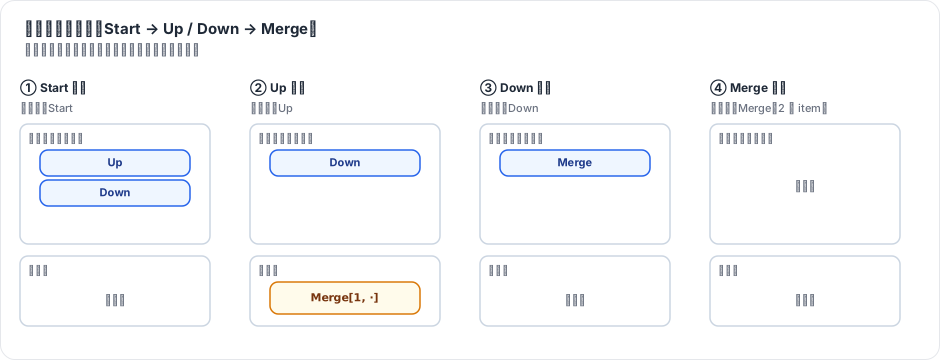
图 7-1:并行分支汇入 Merge 的例子。Up 运行后,Merge 的输入 0 有了数据,输入 1 还没有,于是 Merge 进入等待区;Down 运行后输入到齐,Merge 进栈执行。
2. n8n 是怎么做的
本节按执行的时间顺序读 packages/core/src/execution-engine/workflow-execute.ts。
2.1 初始化:栈里只有起始节点
// packages/core/src/execution-engine/workflow-execute.ts:204-218
// Initialize the data of the start nodes
const nodeExecutionStack: IExecuteData[] = [
	{
		node: startNode,
		data: triggerToStartFrom?.data?.data ?? {
			main: [
				[
					{
						json: {},
					},
				],
			],
		},
		source: null,
	},
];
起始节点的输入是一个空 item { json: {} }。如果是 Webhook 触发的执行,triggerToStartFrom.data 就是收到的请求。
2.2 主循环的骨架
// packages/core/src/execution-engine/workflow-execute.ts:2289-2333(节选)
executionLoop: while (this.isExecutionStackNotEmpty()) {
	if (this.shouldStopExecuting()) {
		return;                                   // 取消或超时
	}
	...
	executionData = this.popExecutionStack();     // 从栈顶取一项
	executionNode = executionData.node;
	...
	runIndex = this.computeRunIndex(executionData);

	currentExecutionTry = `${executionNode.name}:${runIndex}`;
	if (currentExecutionTry === lastExecutionTry) {
		throw new UserError('Stopped execution because it seems to be in an endless loop');
	}

	if (this.isNodeFilteredOut(executionNode.name)) {
		continue;                                 // 部分执行时不在范围内的节点
	}

	const hasInputData = this.ensureInputData(workflow, executionNode, executionData);
	if (!hasInputData) {
		lastExecutionTry = currentExecutionTry;
		continue executionLoop;
	}
popExecutionStack() 是 shift(),取数组 头部(第 2211 行)。runIndex 就是这个节点已经运行过的次数:
// packages/core/src/execution-engine/workflow-execute.ts:1821-1829
private computeRunIndex(executionData: IExecuteData): number {
	if (executionData.runIndex !== undefined) {
		return executionData.runIndex;
	}
	const { runData } = this.runExecutionData.resultData;
	const nodeName = executionData.node.name;
	return Object.hasOwn(runData, nodeName) ? runData[nodeName].length : 0;
}所以“一个节点运行多次”在数据结构里非常自然:runData[name] 是一个数组,每次运行追加一条。
“死循环检测”很朴素:如果同一个节点、同一个 runIndex 连续被取出两次,说明它被放回栈里却一直不能执行(例如等待永远不会到的输入),直接报错。
2.3 运行节点、记录结果
接下来是 nodeExecuteBefore 钩子、重试循环(第 8 章)、runNode()(第 2383 行),以及 Agent 专用的 EngineRequest 分支(第 19 章)。拿到 nodeSuccessData 后,引擎做几件通用的事:
assignPairedItems:自动补全pairedItem(第 6 章)。ensureAlwaysOutputData:节点设置了“总是输出数据”而输出为空时,补一个空 item。- 输出为
null时,这条分支到此结束(continue executionLoop,第 2452–2457 行)。 - 写入
runData,处理waitTill(Wait 节点,第 8 章)和destinationNode(部分执行的终点)。
2.4 分发输出:子节点进栈
// packages/core/src/execution-engine/workflow-execute.ts:2545-2594(节选)
for (outputIndex in workflow.connectionsBySourceNode[executionNode.name].main) {
	...
	for (connectionData of workflow.connectionsBySourceNode[executionNode.name].main[outputIndex] ?? []) {
		...
		if (
			nodeSuccessData![outputIndex] &&
			(nodeSuccessData![outputIndex].length !== 0 ||
				(connectionData.index > 0 && this.isLegacyExecutionOrder(workflow)))
		) {
			// Add the node only if it did execute or if connected to second "optional" input
			if (workflow.settings.executionOrder === 'v1') {
				const nodeToAdd = workflow.getNode(connectionData.node);
				nodesToAdd.push({ position: nodeToAdd?.position || [0, 0], connection: connectionData, outputIndex: parseInt(outputIndex, 10) });
			} else {
				this.addNodeToBeExecuted(workflow, connectionData, parseInt(outputIndex, 10), executionNode.name, nodeSuccessData!, runIndex);
			}
		}
	}
}关键条件:某个输出有 item,才把这个输出连着的节点加入执行。If 的 false 输出为空,false 分支上的节点就不会进栈——动态分支就是这么实现的,没有任何“跳转”指令。
v1 顺序下,先收集所有要加的子节点,再按画布位置排序:
// packages/core/src/execution-engine/workflow-execute.ts:2595-2621(节选)
if (workflow.settings.executionOrder === 'v1') {
	// Always execute the node that is more to the top-left first
	nodesToAdd.sort((a, b) => {
		if (a.position[1] < b.position[1]) {
			return 1;
		}
		if (a.position[1] > b.position[1]) {
			return -1;
		}
		if (a.position[0] > b.position[0]) {
			return -1;
		}
		return 0;
	});
	for (const nodeData of nodesToAdd) {
		this.addNodeToBeExecuted(workflow, nodeData.connection, nodeData.outputIndex, executionNode.name, nodeSuccessData!, runIndex);
	}
}
排序是 降序(y 大的在前),因为接下来 addNodeToBeExecuted 在 v1 下用 unshift 把节点插到栈 头部。后插入的先执行,所以 y 最小(最靠上)的节点最后插入、最先执行。
全部子节点处理完,才调用 nodeExecuteAfter 钩子(第 2626–2634 行)。
2.5 addNodeToBeExecuted:进栈还是进等待区
// packages/core/src/execution-engine/workflow-execute.ts:469-487(节选)
addNodeToBeExecuted(workflow, connectionData, outputIndex, parentNodeName, nodeSuccessData, runIndex, newRunIndex?, metadata?): void {
	let stillDataMissing = false;
	const enqueueFn = workflow.settings.executionOrder === 'v1' ? 'unshift' : 'push';
	let waitingNodeIndex: number | undefined;

	// Check if node has multiple inputs as then we have to wait for all input data
	// to be present before we can add it to the node-execution-stack
	const numberOfInputs =
		workflow.connectionsByDestinationNode[connectionData.node]?.main?.length ?? 0;
	if (numberOfInputs > 1) {
两条路:
- 只有一个输入:直接把
{ node, data: { main: [输出数据] }, source }放进栈(v1 头部,v0 尾部)。 - 有多个输入:在
waitingExecution[节点名][runIndex].main里找一个“这个输入还空着(null)”的槽位,把数据放进去。然后检查所有输入是否都非null(第 569 行起):都到齐就放进栈并从等待区删除;否则留在等待区。
waitingExecution 的结构是“节点名 → runIndex → 每个输入的数据”。用 runIndex 作为第二层键,是为了在循环里区分“第一轮的 Merge”和“第二轮的 Merge”。
2.6 栈空了,但还有节点在等
回到 2.2 节 If + Merge 的例子:If 的 false 分支为空,Merge 的输入 1 永远 不会到。栈空时,主循环末尾会检查等待区:
// packages/core/src/execution-engine/workflow-execute.ts:2640-2700(节选)
if (
	this.runExecutionData.executionData!.nodeExecutionStack.length === 0 &&
	waitingNodes.length
) {
	// There are no more nodes in the execution stack. Check if there are
	// waiting nodes that do not require data on all inputs and execute them,
	// one by one.
	for (let i = 0; i < waitingNodes.length; i++) {
		...
		// Check if the node is only allowed execute if all inputs received data
		let requiredInputs =
			workflow.settings.executionOrder === 'v1' ? nodeType.description.requiredInputs : undefined;
		...
		const parentNodes = workflow.getParentNodes(nodeName);
		// Check if input nodes (of same run) got already executed
		const parentIsWaiting = parentNodes.some((value) => waitingNodes.includes(value));
		if (parentIsWaiting) {
			// Execute node later as one of its dependencies is still outstanding
			continue;
		}
逻辑是:
- 如果某个等待节点的祖先也在等,先不动它(祖先以后可能还会产生数据)。
- 检查
requiredInputs:Merge 在多数模式下是1,有一个输入有数据就够了;“选择分支”模式是[0, 1],必须两个都到。 - 满足条件就把它放进栈,缺的输入用空数组
[]补齐(第 2741–2756 行)。每次只放一个,放完就break,回到主循环。
这个机制让“If 之后再 Merge”这种最常见的写法能正确工作。
2.7 v0 与 v1:两种执行顺序
workflow.settings.executionOrder 有两个取值:
| v0(legacy) | v1(默认) | |
|---|---|---|
| 入栈方式 | push(尾部) | unshift(头部) |
| 遍历顺序 | 广度优先:先把同一层的节点跑完 | 深度优先:一条分支跑到底,再跑下一条 |
| 兄弟节点顺序 | 按连接顺序 | 按画布位置:上方优先,同高度时左边优先 |
| 多输入节点缺输入 | 主动去执行缺失输入的祖先(第 653–800 行的一大段) | 不追,等栈空时按 requiredInputs 放行 |
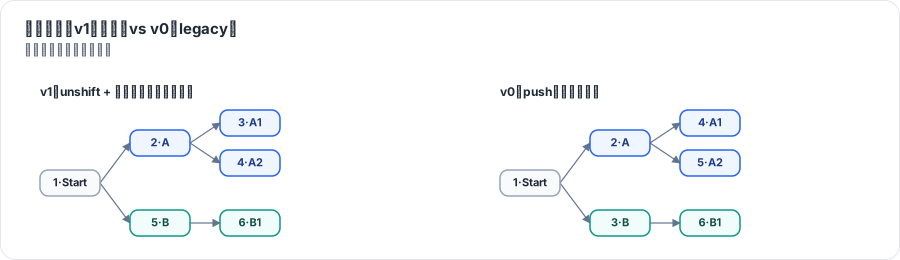
图 7-2:同一棵树,v1 先把上面的 A 分支跑完(A → A1 → A2)再跑 B;v0 先跑完第一层(A、B),再跑第二层。
v0 那一大段“主动追祖先”的代码在 v1 下直接跳过:
// packages/core/src/execution-engine/workflow-execute.ts:706-710
if (!this.isLegacyExecutionOrder(workflow)) {
	// Do not automatically follow all incoming nodes and force them
	// to execute
	continue;
}
v1 的好处是 可预测:用户看画布就知道顺序(从上到下、一条分支跑到底),分支内部的数据依赖也更自然。新工作流默认都是 v1。
2.8 循环
Loop Over Items 的 loop 输出连到循环体,循环体再连回 Loop 节点。引擎并不知道“这是个循环”,它只是照常执行:
- Loop 第一次运行(runIndex 0):把所有 item 存进节点上下文,输出第一批到 loop 输出。
- 循环体运行,输出又连回 Loop → Loop 进栈。
- Loop 第二次运行(runIndex 1):收集上一批结果,输出下一批……
- 没有剩余 item 时,把收集到的所有结果从 done 输出发出,loop 输出为空,循环结束。
节点状态存在 this.getContext('node') 里(executionData.contextData),和执行数据一起序列化,所以循环中途 Wait 也没问题(packages/nodes-base/nodes/SplitInBatches/v3/SplitInBatchesV3.node.ts:93)。
3. 从零实现
mini-n8n 的引擎保留了上面所有语义,主循环约 120 行。
3.1 主循环
// code/mini-n8n/packages/core/src/workflow-execute.ts(节选)
executionLoop: while (stack.length !== 0 || this.releaseWaitingNode(workflow)) {
	if (this.abortController.signal.aborted) break;

	const executionData = stack.shift()!;
	const node = executionData.node;
	const runIndex = runData[node.name]?.length ?? 0;

	const currentTry = `${node.name}:${runIndex}`;
	if (currentTry === lastExecutionTry) {
		throw new WorkflowOperationError('Stopped execution because it seems to be in an endless loop');
	}
	lastExecutionTry = currentTry;

	const filter = this.runExecutionData.startData.runNodeFilter;
	if (filter && !filter.includes(node.name)) continue;
	...
	await hooks.runHook('nodeExecuteBefore', [node.name, taskStarted]);
	// 重试循环 → runNode → assignPairedItems(第 8 章)
	...
	(runData[node.name] ??= []).push(taskData);
	...
	// 分发输出
	const outputs = workflow.connectionsBySourceNode[node.name]?.main ?? [];
	const toAdd = [];
	outputs.forEach((connections, outputIndex) => {
		if (!nodeSuccessData![outputIndex]?.length) return;      // 空输出:下游不执行
		for (const connection of connections ?? []) {
			toAdd.push({ connection, outputIndex, position: workflow.nodes[connection.node]?.position ?? [0, 0] });
		}
	});
	if (workflow.settings.executionOrder === 'v1') {
		// unshift reverses the order, so sort bottom-right first to run top-left first
		toAdd.sort((a, b) => b.position[1] - a.position[1] || b.position[0] - a.position[0]);
	}
	for (const { connection, outputIndex } of toAdd) {
		this.addNodeToBeExecuted(workflow, connection, outputIndex, node.name, nodeSuccessData, runIndex);
	}

	// Like n8n: the hook runs after the children were scheduled
	await hooks.runHook('nodeExecuteAfter', [node.name, taskData, this.runExecutionData]);
}
一个小改动:n8n 在循环 末尾 检查“栈空但有节点在等”,mini-n8n 把它放进了 while 条件里:stack.length !== 0 || this.releaseWaitingNode(workflow)。语义相同,读起来更直接:“栈里还有活,或者能从等待区放出一个,就继续”。
3.2 addNodeToBeExecuted
// code/mini-n8n/packages/core/src/workflow-execute.ts(节选)
addNodeToBeExecuted(workflow, connection, outputIndex, parentNodeName, nodeSuccessData, runIndex): void {
	const node = workflow.nodes[connection.node];
	const source = { previousNode: parentNodeName, previousNodeOutput: outputIndex, previousNodeRun: runIndex };
	const numberOfInputs = workflow.connectionsByDestinationNode[connection.node]?.main?.length ?? 0;

	if (numberOfInputs <= 1) {
		this.enqueue(workflow, { node, data: { main: [nodeSuccessData[outputIndex]] }, source: { main: [source] } });
		return;
	}

	const { waitingExecution, waitingExecutionSource } = this.runExecutionData.executionData;
	const waiting = (waitingExecution[connection.node] ??= {});
	const waitingSource = (waitingExecutionSource[connection.node] ??= {});

	// Use the oldest waiting run that still misses data on this input
	let slot = Object.keys(waiting).map(Number).sort((a, b) => a - b)
		.find((k) => waiting[k].main[connection.index] === null);
	if (slot === undefined) {
		slot = Math.max(this.runExecutionData.resultData.runData[connection.node]?.length ?? 0, ...Object.keys(waiting).map((k) => Number(k) + 1));
		waiting[slot] = { main: Array.from({ length: numberOfInputs }, () => null) };
		waitingSource[slot] = { main: Array.from({ length: numberOfInputs }, () => null) };
	}
	waiting[slot].main[connection.index] = nodeSuccessData[outputIndex];
	waitingSource[slot].main[connection.index] = source;

	if (waiting[slot].main.every((d) => d !== null)) {
		this.enqueue(workflow, { node, data: waiting[slot], source: waitingSource[slot] });
		delete waiting[slot];
		...
	}
}
null 表示“还没收到”,[] 表示“收到了,但是空的”。这个区别在 releaseWaitingNode 里很重要:只有 null 的输入才算缺失。
3.3 releaseWaitingNode
// code/mini-n8n/packages/core/src/workflow-execute.ts(节选)
private releaseWaitingNode(workflow: Workflow): boolean {
	const { waitingExecution, waitingExecutionSource } = this.runExecutionData.executionData;
	let waitingNodes = Object.keys(waitingExecution);
	for (let i = 0; i < waitingNodes.length; i++) {
		const nodeName = waitingNodes[i];
		...
		// a parent that is itself waiting will produce data later
		if (workflow.getParentNodes(nodeName).some((p) => waitingNodes.includes(p))) continue;

		const firstSlot = Math.min(...Object.keys(waitingExecution[nodeName]).map(Number));
		const inputs = waitingExecution[nodeName][firstSlot].main;
		const inputsWithData = inputs.map((d, idx) => (d === null ? null : idx)).filter((d) => d !== null);

		const required = nodeType.description.requiredInputs;
		if (Array.isArray(required) && !required.every((r) => inputsWithData.includes(r))) continue;
		if (typeof required === 'number' && inputsWithData.length < required) continue;

		const main = inputs.map((d) => d ?? []);
		...push to stack, delete slot, return true
	}
	return false;
}
3.4 差异
| 方面 | n8n | mini-n8n |
|---|---|---|
| v1 调度 | 位置排序 + unshift + 栈空放行 | 相同 |
| v0 调度 | push + 主动执行缺失输入的祖先 | 只有 push,没有 实现“追祖先” |
requiredInputs | 数字、数组或表达式 | 数字或数组 |
| 栈空放行的位置 | 循环末尾 | while 条件 |
| 部分执行 | runPartialWorkflow2:基于 DirectedGraph 重建栈,支持“脏节点” | 只支持 destinationNode + 祖先过滤 |
| 取消 | PCancelable + AbortController | cancel() + AbortController |
4. 运行与验证
examples/execution-order.ts 在每个节点运行后打印栈和等待区(等待区里 · 表示该输入还没数据):
cd code/mini-n8n && npx tsx examples/execution-order.ts真实输出:
=== tree (executionOrder v1) ===
ran Start    out 1    stack [A, B]  waiting {}
ran A        out 1    stack [A1, A2, B]  waiting {}
ran A1       out 1    stack [A2, B]  waiting {}
ran A2       out 1    stack [B]  waiting {}
ran B        out 1    stack [B1]  waiting {}
ran B1       out 1    stack []  waiting {}

=== tree (executionOrder v0) ===
ran Start    out 1    stack [A, B]  waiting {}
ran A        out 1    stack [B, A1, A2]  waiting {}
ran B        out 1    stack [A1, A2, B1]  waiting {}
ran A1       out 1    stack [A2, B1]  waiting {}
ran A2       out 1    stack [B1]  waiting {}
ran B1       out 1    stack []  waiting {}

=== parallel branches + merge (executionOrder v1) ===
ran Start    out 1    stack [Up, Down]  waiting {}
ran Up       out 1    stack [Down]  waiting {Merge[1,·]}
ran Down     out 1    stack [Merge]  waiting {}
ran Merge    out 2    stack []  waiting {}

=== if + merge, false branch empty (executionOrder v1) ===
ran Start    out 1    stack [If]  waiting {}
ran If       out 1/0  stack [Yes]  waiting {}
ran Yes      out 1    stack []  waiting {Merge[1,·]}
ran Merge    out 1    stack []  waiting {}

=== loop over items (executionOrder v1) ===
ran Start    out 1    stack [Data]  waiting {}
ran Data     out 3    stack [Loop]  waiting {}
ran Loop     out 0/2  stack [Body]  waiting {}
ran Body     out 2    stack [Loop]  waiting {}
ran Loop     out 0/1  stack [Body]  waiting {}
ran Body     out 1    stack [Loop]  waiting {}
ran Loop     out 3/0  stack [Done]  waiting {}
ran Done     out 3    stack []  waiting {}
逐段看:
- tree v1:A 运行后,A1、A2 被插到栈头,排在 B 前面——深度优先。
- tree v0:A 运行后,A1、A2 被追加到栈尾,B 先执行——广度优先。
- parallel + merge:Up 运行后 Merge 只收到输入 0(
[1,·]),进等待区;Down 运行后输入到齐,Merge 进栈。 - if + merge:If 输出
1/0,No 分支没有进栈;Yes 运行后 Merge 进等待区;此时栈空,releaseWaitingNode根据requiredInputs: 1放行 Merge,缺的输入补[]。 - loop:Loop 运行了 3 次(
0/2、0/1、3/0),前两次只有 loop 输出有数据,最后一次只有 done 输出有数据。
引擎的单元测试(packages/core/test/workflow-execute.test.ts)对这些场景都有断言:
npx vitest run packages/core ✓ packages/core/test/workflow-execute.test.ts (17 tests)5. 练习
- 巩固:在纸上模拟下面这个工作流在 v1 下的执行顺序,然后用 mini-n8n 验证:Start → If(true 有 2 个 item,false 有 1 个)→ 两个分支各接一个 Set → 都连到同一个 Merge → Code。
- 扩展:mini-n8n 的 v0 没有实现“追祖先”。构造一个例子,说明 v0 在 n8n 里和 mini-n8n 里会产生不同结果(提示:Merge 的输入 1 连在一个没有被任何节点触发的 Set 上)。
- 读源码:阅读 n8n 的
runPartialWorkflow2(同文件)和packages/core/src/execution-engine/partial-execution-utils/,说明部分执行时引擎如何决定“从哪些节点开始”。
6. 延伸阅读
packages/core/src/execution-engine/workflow-execute.ts:本章的全部内容,重点读addNodeToBeExecuted和processRunExecutionData。packages/core/src/execution-engine/partial-execution-utils/:DirectedGraph、findStartNodes、recreateNodeExecutionStack等部分执行工具。- n8n 文档:Flow logic → Execution order in multi-branch workflows。